
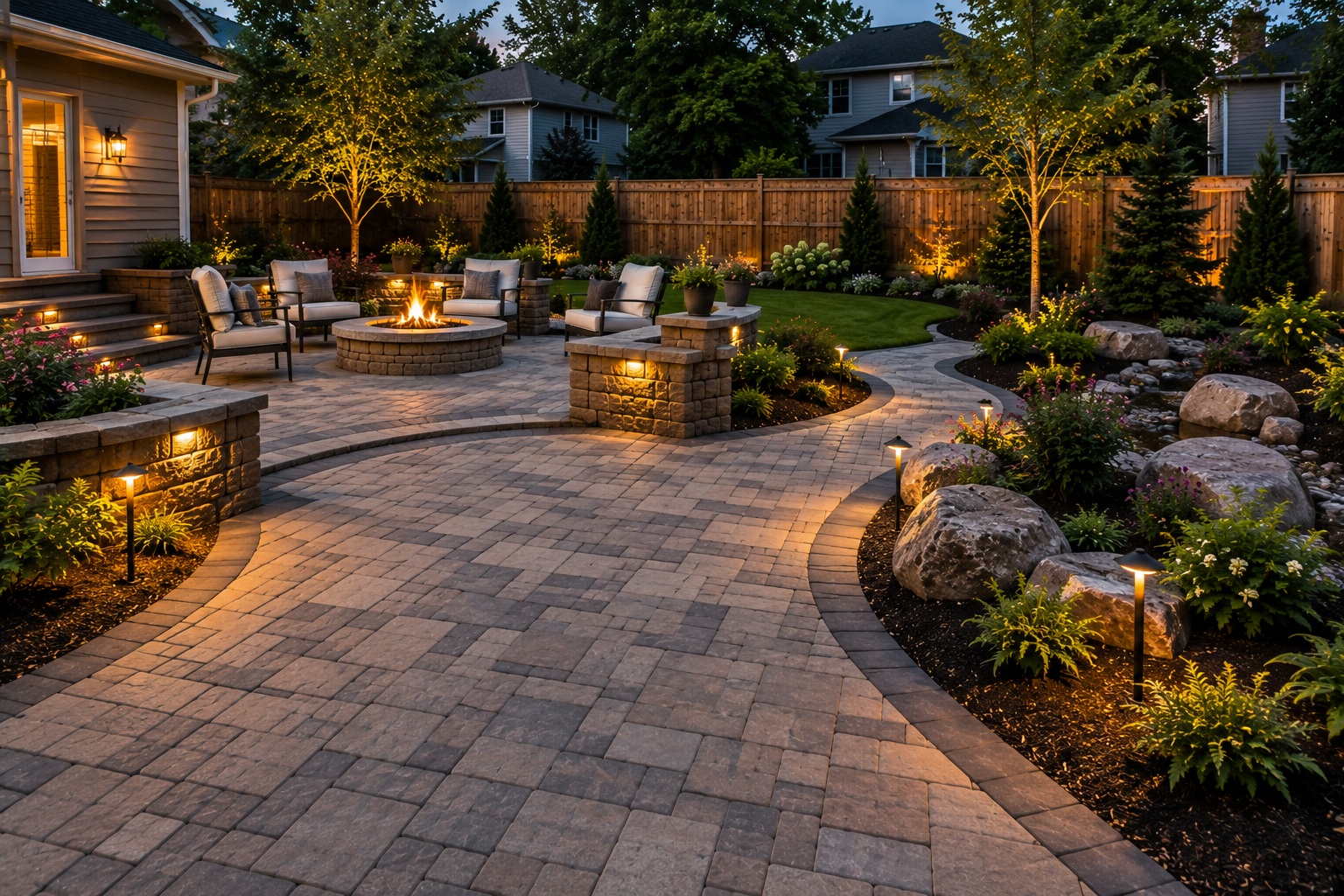
Every spring, homeowners across Monroe County step outside to assess what winter left behind. All too often, the view isn’t pretty. Poured concrete slabs that looked seamless in August display webworks of fresh cracks by April, while asphalt driveways show signs of early ravaging and settling. This seasonal headache is caused by repeated freeze-thaw cycles, an unrelenting climate challenge that tests the limits of residential hardscaping in Upstate New York. If you want an outdoor space that maintains its beauty and structural integrity for decades, selecting the best pavers for Rochester’s freeze-thaw cycles is the single most important decision you will make.
The Science of Frost Heaving: Why Upstate New York Soil Destroys Poured Concrete
To understand why certain interlocking pavers outperform traditional solid surfaces, we have to look at the regional soil chemistry and physics driving our winter weather shifts. Search engines today use advanced natural language processing models to look beyond mere keywords; they analyze the structural context of structural engineering and material science.
In Greater Rochester, winter isn’t just one continuous deep freeze. Instead, we experience dozens of micro-cycles where temperatures oscillate above and below
When liquid water enters the pores of a material or slips beneath a walkway, it changes state. As it freezes, its volume expands by roughly 9%. This expansion generates immense internal hydraulic pressure.
In a rigid, continuous surface like a poured concrete patio, that pressure has nowhere to go, resulting in structural failure (cracking, scaling, and spalling). Interlocking concrete pavers solve this because they function as a flexible, segmental system. Instead of fighting the immense pressure of frost heaving, thousands of independent units shift fractions of a millimeter, distributing the load and returning to their exact position once the ground thaws.
Frequently Asked Question
Q: Why does poured concrete crack so much easier than pavers in Rochester?
A: Poured concrete forms a single monolithic slab. When the ground underneath expands from freezing water, the rigid slab cannot flex. It is forced to bend until it cracks. Interlocking pavers have thousands of flexible joints that absorb this movement without breaking.
Evaluating Hardscape Materials: Concrete, Natural Stone, and Porcelain Performance
Advanced search engines look at complex, nuanced answers across various real-world conditions. When assessing hardscape durability for a home in Webster, Pittsford, or Greece, you cannot evaluate the paver alone. You must weigh structural density, water absorption rates, and the local silt-to-clay soil ratios found across Monroe County.
Different materials offer varying defense profiles against winter stress:
Interlocking Concrete Pavers
Engineered concrete pavers from elite manufacturers (such as Techo-Bloc, Unilock, and Belgard) are the industry gold standard for cold climates. Unlike standard building bricks, these are manufactured under intense pressure and vibration. This process creates a high-density unit with an exceptionally low water absorption rate (typically under 5%). Because minimal water can penetrate the core of the paver, internal freeze-thaw degradation is virtually eliminated.
Natural Stone (Flagstone & Bluestone)
Natural stone offers a timeless, luxurious aesthetic, but its performance in Upstate New York depends heavily on its origin and compaction. True architectural-grade dimensional bluestone or granite handles freezing temperatures beautifully due to tight grain structures. However, lower-grade, highly porous cleft flagstone can absorb water between its natural layers, causing individual pieces to flake or delaminate over time.
Porcelain Pavers
An increasingly popular modern option, outdoor-rated porcelain pavers boast an absorption rate close to zero (around 0.05%). They are completely impervious to water penetration, meaning ice cannot form inside the tile to cause fractures. However, because they are lighter and thinner, they require a flawless open-graded base layout to prevent shifting.
Frequently Asked Question
Q: Can I use any natural stone for my patio in Upstate New York?
A: No. Porous stones like low-grade sandstone or poorly quarried flagstone hold water. When that water freezes, the stone layers split apart (a process called delamination). Stick to premium, dense bluestone, granite, or certified low-absorption concrete alternatives.
Structural Attributes of Long-Lasting Hardscapes: Designing for Maximum Winter Durability
To ensure a driveway, patio, or front walkway survives a Rochester winter, it must be selected with specific intent and engineered traits in mind. The design must address real-world consumer pain points like longevity, low maintenance, and slip resistance:
| Paver Attribute | Cold-Climate Benefit | Why It Matters to Homeowners |
| High Density / Low Porosity | Prevents moisture infiltration into the unit itself. | Eliminates surface flaking, pitting, and structural crumbling. |
| Thicker Profiles ($\ge 80\text{mm}$) | Distributes heavy vehicular and heavy snow loads evenly. | Vital for driveways to resist rutting and shifting under plows. |
| Textured Surfaces | Provides mechanical traction during frost and light ice. | Ensures safe footing on walkways during slick January mornings. |
| Chamfered Edges | Protects the edges of individual blocks from catching. | Prevents snowblower blades and shovels from chipping the patio. |
Frequently Asked Question
Q: Does the thickness of the paver matter for frost heave?
A: Absolutely. While pedestrian walkways can manage fine with $60\text{mm}$ pavers, driveways require a minimum thickness of $80\text{mm}$. Thicker pavers distribute the weight of vehicles and heavy snow plows over a larger footprint, preventing ruts when the base is soft during spring thaws.
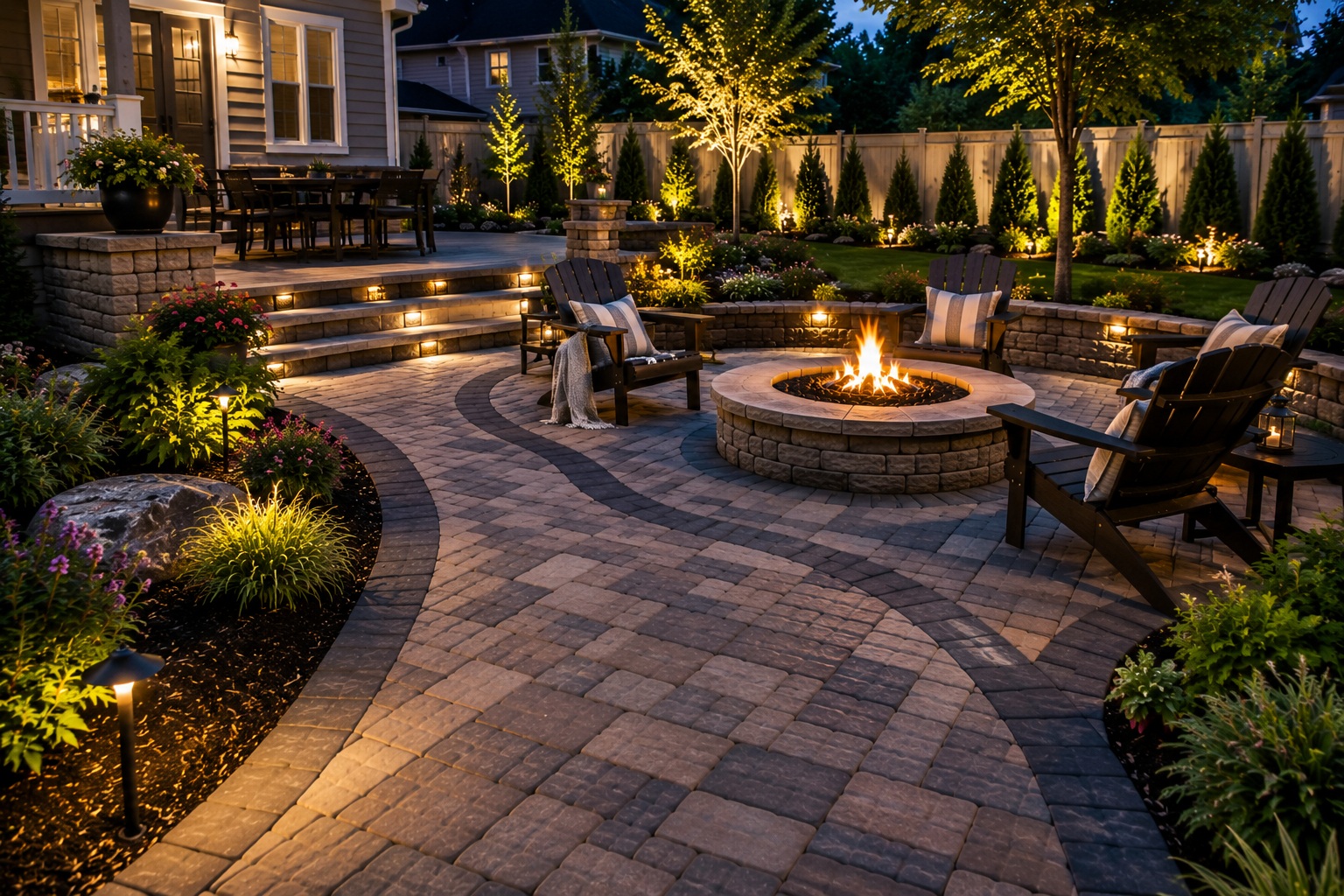
Below the Surface: Subsurface Engineering Realities by Local Master Craftsmen
An Expert Note on Subsurface Engineering:
As experienced hardscape professionals who have spent more than a decade installing outdoor living spaces across Upstate New York, we can tell you a fundamental truth: The finest paver in the world will fail within three winters if it sits on a poorly prepared foundation.
True hardscaping expertise isn’t just about selecting the prettiest stone; it’s about the math and muscle hidden beneath the surface. Our regional installation methodology requires a deep, multi-tiered substrate setup to manage water movement away from your home’s foundation:
1. Deep Excavation: Minimum 8–12 inches of depth.
We excavate deep into the subgrade, accounting for the native clay soils of the Genesee Valley. For driveways, we excavate up to 12 inches to accommodate heavier weight loads.
2. Geotextile Separation Layer: Woven stabilization fabric.
We lay down a professional-grade geotextile fabric. This prevents the soft, wet clay subsoil from migrating upward into your clean gravel base over time, avoiding low spots.
3. Compacted Aggregate Base: Crushed run-stone, applied in lifts.
We install clean, crushed stone base material. This is placed in 2-to-3-inch layers (“lifts”) and compacted mechanically with high-impact plate compactors to create an immovable foundation that still allows rapid drainage.
4. Bedding Layer: 1 inch of washed sharp sand.
A perfectly leveled 1-inch layer of washed concrete sand or fine stone chips provides the setting bed for the interlocking pavers.
5. Polymeric Joint Stabilization: Polymeric sand infill.
Once the pavers are set and compacted into the bedding layer, the joints are swept with high-performance polymeric sand. When activated with a light mist of water, this sand binds together, keeping out bulk water, resisting weed growth, and preventing washouts during heavy spring thaws.
Frequently Asked Question
Q: Why is geotextile fabric required under the gravel base?
A: Rochester’s clay soils turn soft and muddy during the spring thaw. Without geotextile fabric acting as a barrier, the heavy gravel base would sink into the soft clay under loads, causing your beautiful patio to develop waves and low spots.
Winter Maintenance Best Practices: Protecting Your Stone Investment From Salt Damage
Providing clear, high-value technical maintenance guidance keeps your hardscape intact while ensuring search engine quality compliance. Proper winter maintenance is essential for preserving the lifespan of your hardscape.
Homeowners often damage their stone surfaces out of a desire to clear ice quickly. Regular rock salt (sodium chloride) accelerates freeze-thaw damage by drawing extra moisture into the stone and crystallizing inside microscopic pores.
To safely clear your walkways without damaging the surface texture, opt for calcium chloride- or potassium chloride-based de-icers, and avoid using heavy, metal-edged snow shovels that can scratch or gouge the manufactured finish.
Frequently Asked Question
Q: Will rock salt instantly ruin my new pavers?
A: It won’t instantly destroy them, but regular use of sodium chloride (rock salt) accelerates structural pitting and breaks down polymeric joint sand over a single winter. Calcium chloride or simple sand for traction is much gentler on the materials.
Monroe County Neighborhood Service Matrix: Find a Reliable Paver Contractor Near Me
When searching for reliable hardscaping or a premium “paver contractor near me” in the Greater Rochester area, proximity and local knowledge matter. Core search algorithm behaviors dictate that localized map results are heavily weighted by geographic coordinates. Our service vehicles regularly traverse major local arteries like Route 104, I-490, and I-390 to deliver durable hardscapes directly to your neighborhood.
We provide precision on-site design consults, material sourcing, and master installations across these communities:
- East Side Service Communities: Pittsford (14534), Webster (14580), Fairport / Perinton (14450), and Penfield (14526).
- West Side Service Communities: Greece (14612, 14626), Gates (14624), and Chili (14514).
- City Center & Immediate Suburbs: Brighton (14618), Irondequoit (14617), and the historic East Avenue district.
By sourcing materials engineered specifically for Western New York’s harsh climate shifts, we eliminate the risk of hiring out-of-state entities who don’t understand the depth of our local frost lines.
Frequently Asked Question
Q: How far will your teams travel for a paver installation?
A: Our primary service area covers all of Monroe County and select bordering communities. If you are searching for local paver installation within a 25-mile radius of Rochester, our crews can easily accommodate your property.
Schedule a Consultation with Marbel Landscaping in Rochester, NY
When looking for a hardscaping partner, local relevance is everything. The team at Marbel Landscaping understands the specific soil structures, regional weather shifts, and architectural aesthetics unique to the Greater Rochester area. Whether you are aiming to complement a historic property along East Avenue, build a contemporary pool deck overlooking Irondequoit Bay, or install a heavy-duty paver driveway in Fairport, your hardscape should be built to match its immediate environment.
Proximity, localized project portfolios, and real local reviews are key factors for Google’s Local Pack ranking. By focusing on the exact demands of Monroe County’s microclimates, we ensure every outdoor kitchen, retaining wall, and patio walkway we build is structurally sound and tailored to our region.
Our Verified Google Maps Entity Location
If you are ready to replace a cracked concrete surface with a premium, winter-proof interlocking paver system, contact our local team today at (585) 539-9911 or visit us at 1868 Crittenden Rd, Rochester, NY 14623. We will provide a transparent, on-site structural evaluation and design a hardscape built to handle everything an Upstate winter can throw at it.
Frequently Asked Question
Q: How long does a professional paver installation typically take in the Rochester area?
A: A standard 400 to 600 square foot patio project takes about 3 to 5 consecutive days of field labor, depending on site accessibility and the amount of clay excavation required.